Marking the death anniversary of Sufi mystic Madho Lal Hussain, the rustic festival shines bright in Lahore
By: Dr. Tarunjit Singh Butalia
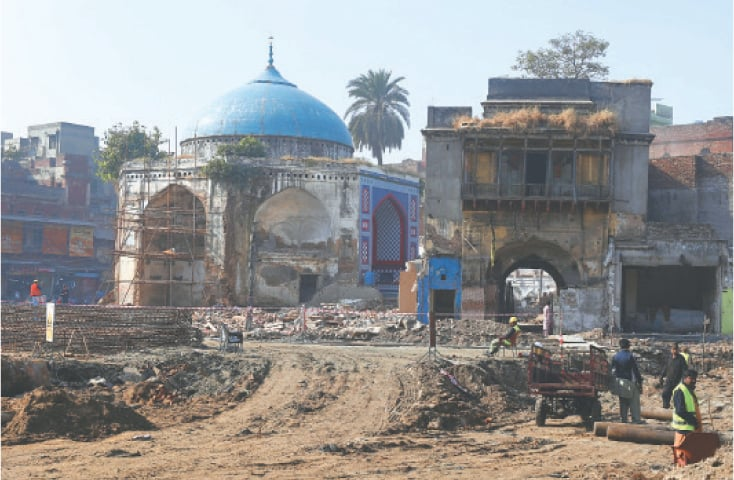
In the small, crowded streets of Baghbanpura in Lahore, to the west of Shalimar Gardens, lies the famous shrine of the Sufi mystic Madho Lal Hussain. His Urs (death anniversary) has been celebrated in Lahore for over 400 years and was recently observed with great enthusiasm during the last weekend of March.
This shrine is the final resting place of the 16th-century Punjabi Muslim Sufi poet Shah Hussain and his close companion Madho Lal, a Hindu Brahmin. Shah Hussain (1538-1599) lived during the time of Mughal Emperor Akbar. He was born in the same year as the passing of Guru Nanak (1469-1538), and 42 years after the death of Bhagat Kabir (1425-1496).
Shah Hussain was so deeply in love with a young Hindu boy, Madho Lal, from Shahdara, just across the Ravi river, that he changed his name to Madho Lal Hussain. Today, their graves sit next to each other.
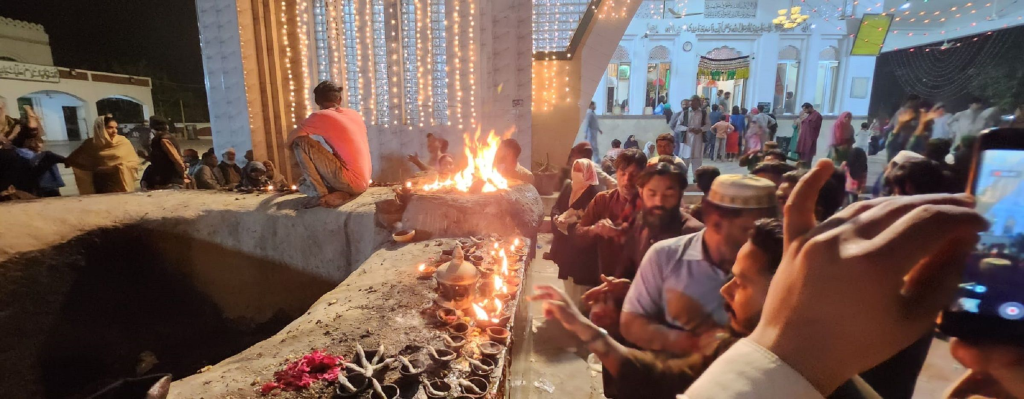
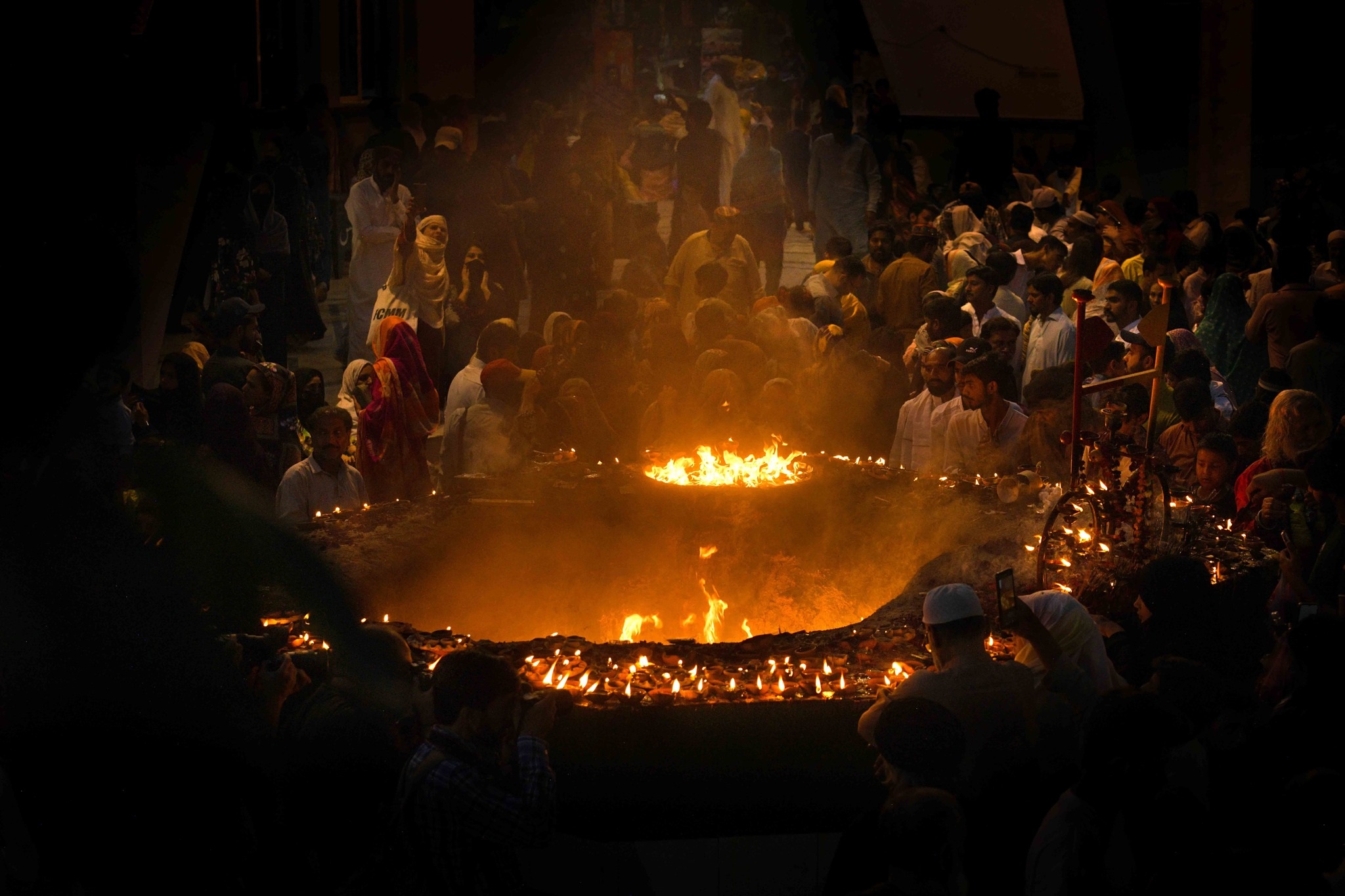
At the centre of the mela is a fire pit, referred to as alao, symbolising the fire of divine love. Men and women offer lamps (chirags) to the fire along with flowers.
Maharaja Ranjit Singh, commonly known as Sher-e-Punjab, who ruled Punjab from Lahore from 1799 to 1839, had profound respect for Shah Hussain, a pioneer of Kaafi poetry, who lived in Lahore. Maharaja Ranjit Singh combined the Urs of Shah Hussain with the cultural festival of Basant into one major event called Mela Chiraghan (Festival of Lights), which was celebrated at the shrine of Shah Hussain. According to historical accounts, Ranjit Singh walked barefoot from his palace in Lahore to the shrine to mark this festival, reinforcing a message of religious co-existence.
The following extract from ‘Umdat ut Tawarikh’ (a Persian court diary maintained by Sohal Lal Suri) from 1824 brings forth the glory of the festival:
“On the 3rd of Rajab, on the 5th of Magh, celebrations of Basant took place with great glory and pomp at the mausoleum of Madho Lal Hussain. Therefore, the Maharaja ordered all the horsemen, platoons, and the like to put on yellow garments and stand in a line, beginning from Delhi Gate to the above-mentioned mausoleum. Consequently, all the triumphant troops put on yellow garments and took their stand outside the town. The Maharaja came out of the fort when one and a half quarters of the day had left. After performing ablutions, he inspected the parade of the troops. After that, he entered the four walls of the mausoleum, gave Rs 125 as Nazar, and then took his seat under a high yellow canopy. After 2 or 3 hours of watching and enjoying the sights of the fair, the Maharaja returned to the fort.”
The British moved the Urs festival from the shrine to Shalimar Gardens. However, in 1958, the festival was moved back to the shrine.
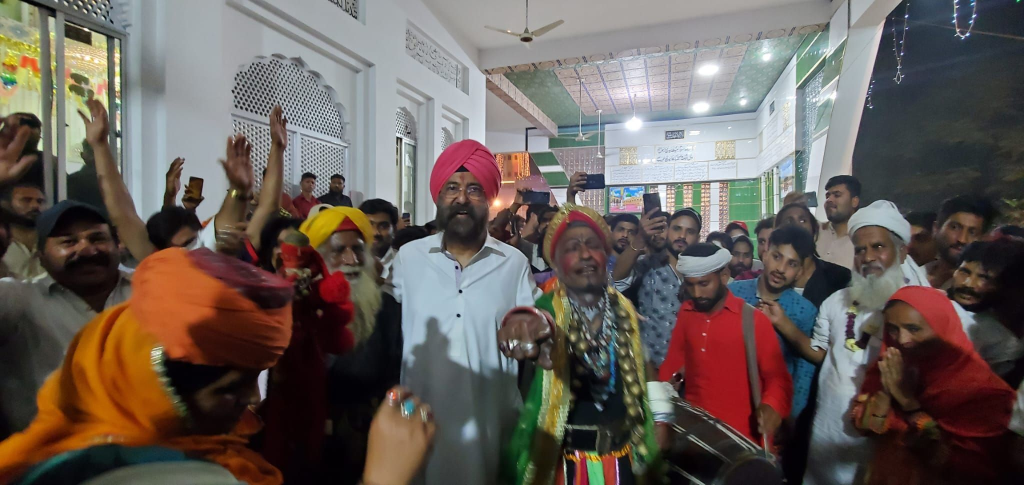
The writer with a malang, a Sufi dancer.
This year, I was invited by the Auqaf Board (the management committee of mosques) to speak at the festival. As I stood up, the urge to speak in Punjabi took over me. I began with the following kaafi of Shah Hussain:
Rabba, mere haal da, mehram tu
Andar tu hain, bahar tu hain,
rom rom vich tu
Tu hain tanna, tu hain banna,
sabh kujh mera tu
Kahe Hussain faqir nimana,
main nahin, sabh tu
(O God, you are the all knower of me,
You are inside me, you are outside me,
you are in every cell of mine,
You are the string of music, you are also
the thread of cloth, you are my everything,
Says the lowly Fakir Hussain, I am nothing, you are everything.)
Later, as I walked out of the event to experience the rustic festival, the first things that caught my eyes and ears were a raging fire in a pit and the throbbing sound of over a dozen dhols (Punjabi drums) playing all over the shrine complex. Hundreds of men, women, and children intermingled freely, making it a truly community festival, with people exchanging jhappis (hugs) and pappis (kisses).
The fire pit, referred to as alao, symbolises the fire of divine love. Men and women offered lamps (chirags) to the fire along with flowers. It was a sight to behold.
To my right, malangs (Sufi dancers) were swaying to the beat of two large dhols. This was Dhammal — a Sufi mystic dance of losing oneself to the beat of drums to experience the divine. I had never experienced this way of connecting with the divine. There were over a dozen such small dancing groups. Each comprised malangs and ordinary locals, many with their long hair open. Some of the malangs had bells tied to their feet and hands. Next to each dance group was a langar, a community kitchen serving free food to all.
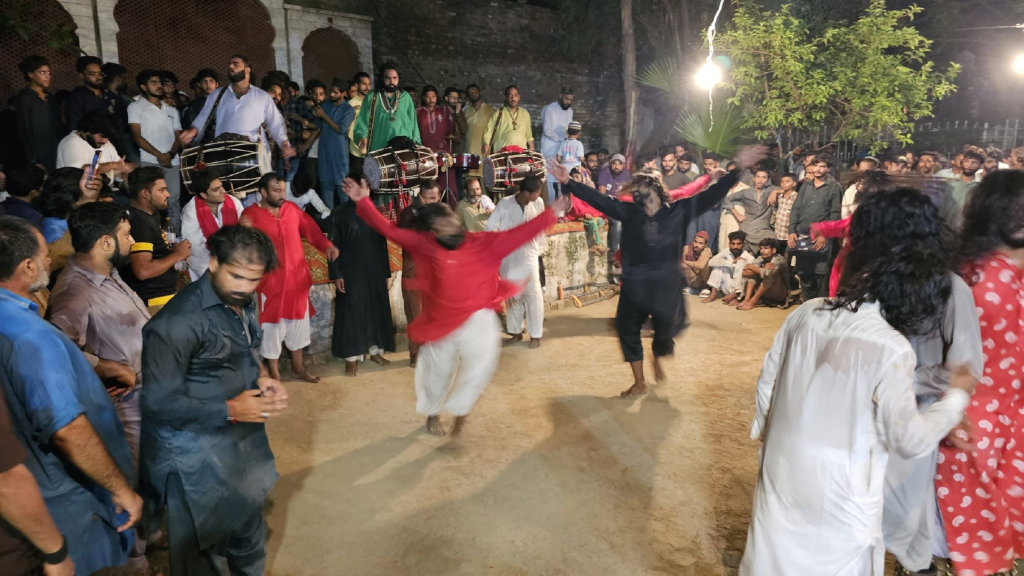
Mela Chiraghan is unique as it honours the deep spiritual bond between Shah Hussain and Madho Lal, symbolising unity across religious and social boundaries. It was a multi-faith festival during the early 19th-century Sikh rule and became a key example of the period’s cultural integration, bringing together people of different faiths.
During this year’s Mela Chiraghan, I was among the few non-Muslims visiting the shrine to pay respects. Thousands of Muslims bowed their heads with equal fervour at the graves of Shah Hussain and Madho Lal. I hope such interfaith respect and understanding run through South Asia.
© The Tribune, April 05, 2026