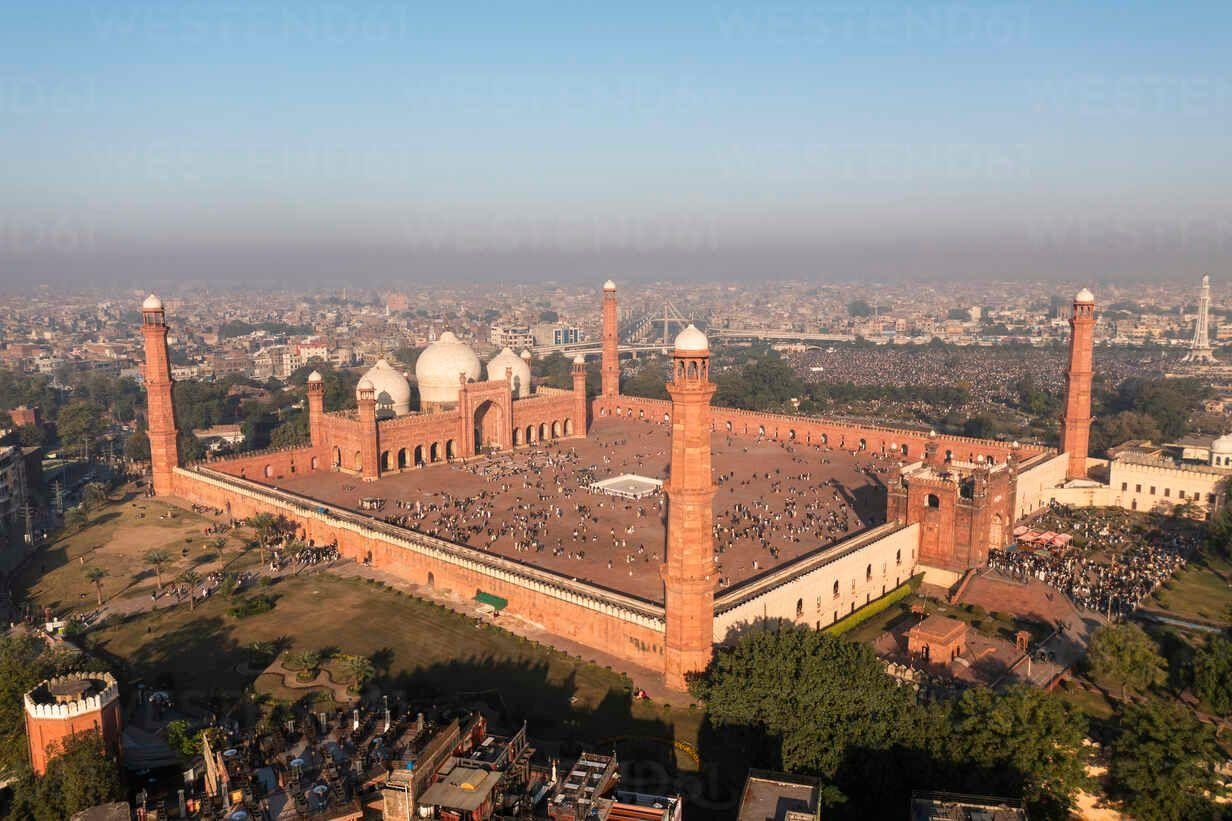
The Badshahi Mosque and the Hazuri Bagh, the ceremonial heart of Mughal Lahore. The Roshnai Gate stood between this precinct and the Ravi river.
Lahore is a city that has always been entered through a door. Before the ring roads, before the flyovers, before the city spilled out across the Punjab plain, there was a brick wall about thirty feet high and a chain of thirteen gateways set into it, each one opening onto a street that led, without hesitation, to a mosque, a market, a tomb or a fort. The wall is gone. Nine of the gates are gone with it. What survives is a system of names that still tells you exactly where you are in the old city, and what the old city once expected of you.
The wall that Akbar built
The standard account, recorded by Syad Muhammad Latif in his magisterial Lahore: Its History, Architectural Remains and Antiquities (New Imperial Press, 1892) and repeated in the modern scholarship, credits the brick fortification of Lahore to the reign of Akbar, who ruled from 1556 to 1605. The wall enclosed an irregular parallelogram of roughly two and a half square kilometres, and its thirteen gates were not decorative. They were the points at which the city was watched, and the points from which the city’s streets began. As U. Kabir and S. Ejaz put it in a recent morphological study, the Walled City was “enclosed historically by Akbar’s fortification wall and organized internally by thirteen gates from which the primary streets (Guzars) originate”.
That double function, defence and circulation, is the key to understanding the gates. Ian Talbot and Tahir Kamran describe them as “a means of egress as well as barriers,” and the phrase is exact: a gate is a piece of military architecture that doubles as a piece of urban planning. The same study notes that the naming of the gates records geography and trade at once: Delhi Gate and Kashmiri Gate are named for the regions they face, and through which their roads run. For centuries Lahore was a transregional clearing house, and its gates were the labelled ends of the trade routes that made it one.
The two great Urdu compendia of Lahore lore, Kanhaiya Lal’s Tarikh e Lahore (1884) and Nur Ahmad Chishti’s Tahqiqat e Chishti, are the base texts from which most later gate tradition descends. Reading them alongside the colonial record, particularly H. R. Goulding’s Old Lahore: Reminiscences of a Resident (Civil and Military Gazette Press, 1924), produces something close to a biography for each gate. It also produces honest disagreement, because the traditions diverge and the physical evidence has largely vanished. Where the sources conflict, this essay says so rather than choosing a version silently.
The geography of the thirteen
The clearest early enumeration is geographic. One colonial study of Lahore’s transformation lists the gates by the side of the wall on which they stood: Roshnai, Kashmiri, Masti and Khizri on the north; Yakki, Delhi and Akbari on the east; Mochi, Shah Almi, Lahori and Mori on the south; Bhatti and Taxali on the west. The same study records a detail that explains a great deal about what happened to the wall: the brick rampart, formerly thirty feet high, was cut down to about fifteen feet by the colonial administration, ostensibly for the sake of sanitation and ventilation.
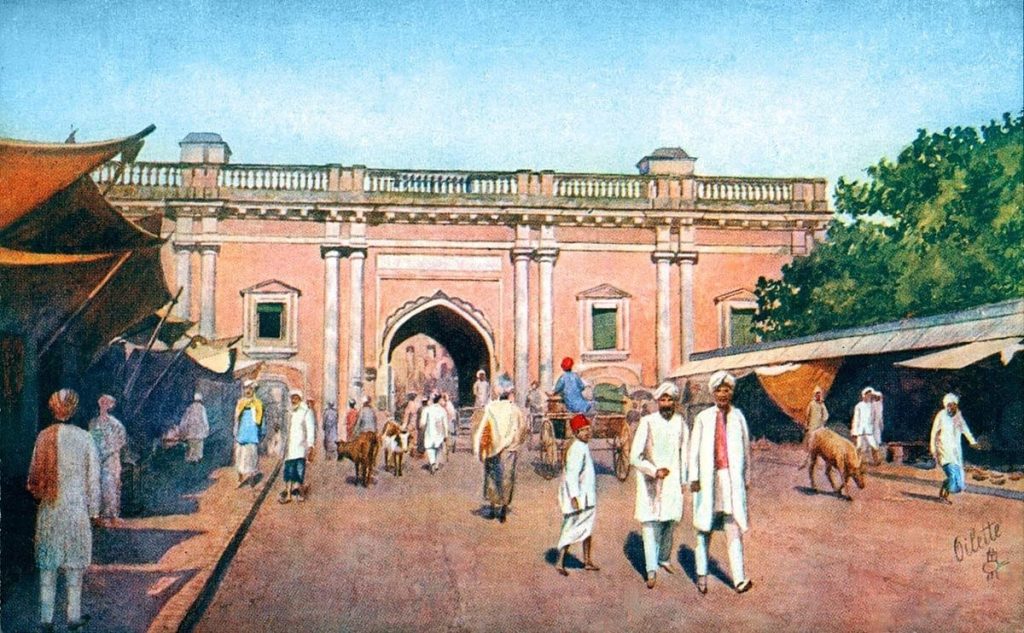
Delhi Gate as the colonial city knew it, in a Raphael Tuck and Sons Oilette postcard. The neoclassical pilasters and rooftop balustrade belong to the nineteenth century rebuilding, not to Akbar’s gate.
The thirteen, then, in the order a traveller would meet them walking anticlockwise from the east.
East: the road to Delhi, the martyr, and the emperor’s market
Delhi Gate:
The principal eastern entrance, built in Akbar’s time and oriented to the Grand Trunk Road and the imperial capital. It was still standing when the British took Lahore from the Sikhs in 1849 but was in poor condition, and the structure visible today is a later reconstruction in a colonial idiom, with a broad scalloped arch, paired pilasters and a white balustrade across the roof. A doctoral study of the Walled City records the sequence precisely: a plaque at the gate sets out its Mughal construction, its demolition in the British period, and its reconstruction by the Walled City of Lahore Authority. In 2015 the gate and the adjacent Shahi Hammam, the Mughal royal bathhouse, were conserved by the Aga Khan Trust for Culture with the Authority, a project that has become the reference standard for the wider programme.
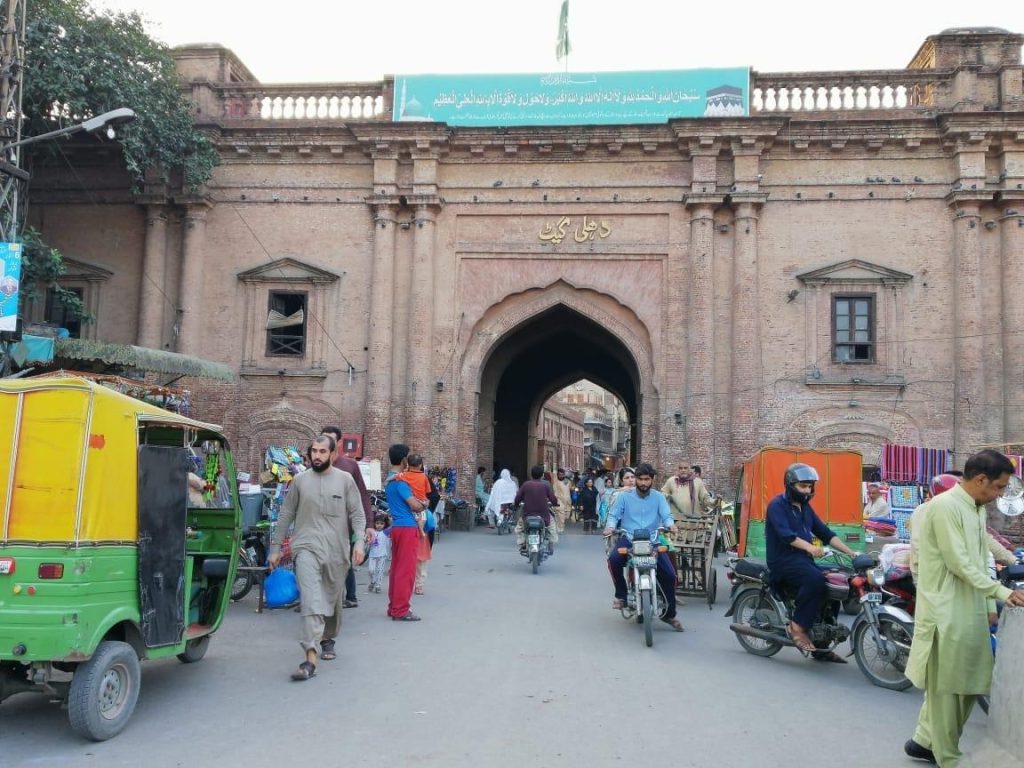
Delhi Gate today, carrying its own name in metal lettering above the arch.
Yakki Gate:
The gate of the martyr. The name is a corruption of Zakki, after Syed Zakki, a saint who is said to have fallen while defending the city against invaders from the north, and whose grave lies inside the gate; popular tradition preserves the grotesque detail that he continued to fight after his head was struck off. The gate structure was lost and has been rebuilt in recent years, which makes it one of the clearest cases of the reconstruction now under way.
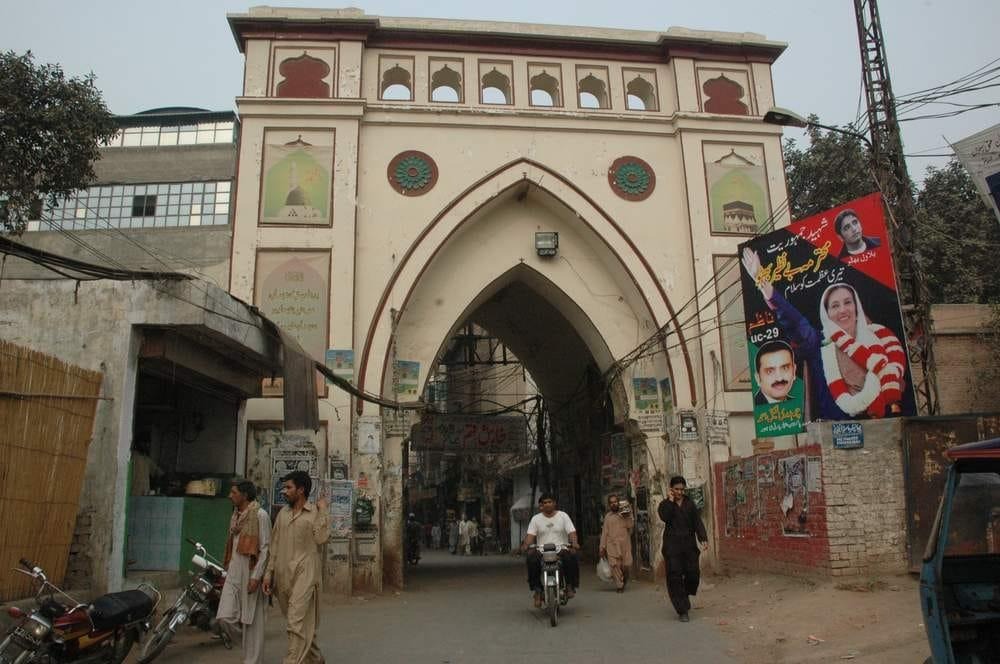
The rebuilt Yakki Gate, with its scalloped arch and rosettes above.
Akbari Gate:
Named for the emperor who remade the city, and inseparable from the market he founded beside it, the Akbari Mandi, which remains the wholesale grain and spice heart of Lahore. The gate itself no longer exists. It was repaired under colonial rule, fell into ruin, and was eventually removed to widen the approach road; the sources disagree on whether the demolition followed the events of 1857 or came as late as the 1950s, and the disagreement is worth recording rather than resolving. What survives is the market, which is arguably the more valuable inheritance.
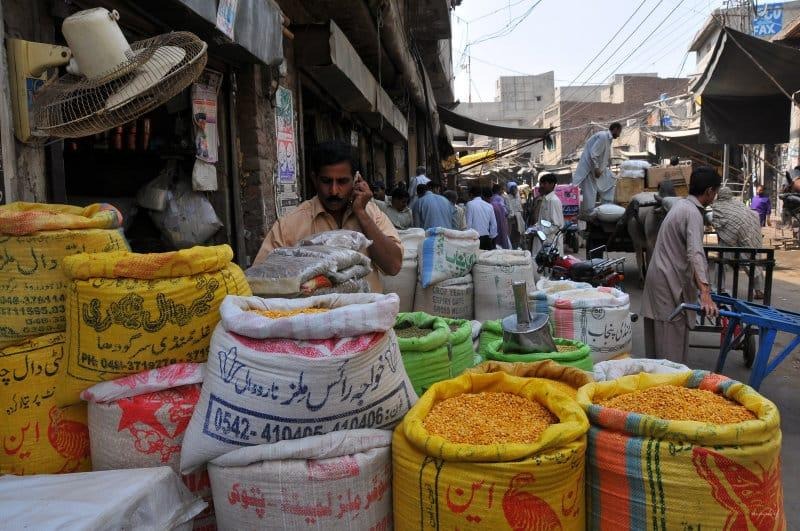
Akbari Mandi, the market Akbar founded outside his gate. The gateway is gone; the trade it served is not.
South: the gatekeepers, the fire, and the smallest door in the city
Mochi Gate:
The name is a settled corruption. The gate was Moti, the pearl, named for Moti Ram, an officer of Akbar’s administration who kept the gate, though a parallel tradition credits a humble guard called Moti who served there all his life. Moti became Mochi, and Mochi then acquired a false but irresistible association with the cobblers who traded nearby. The structure has gone. The square and the bazaar remain, and remain political: Mochi Gate is where Lahore has gathered to argue for two centuries.
Shah Almi Gate:
Named for Shah Alam I, son of Aurangzeb, and known before that as Bherwala Gate. It is the gate of the great rupture. On 20 and 21 June 1947 the Shah Almi Bazar, the most important Hindu commercial space in Lahore, was set alight in an operation that a study in the Journal of the Research Society of Pakistan demonstrates was planned rather than spontaneous, involving named local officials and organised gangs entering through lanes and the canal bed while the main gates were barricaded. Roughly eighty per cent of the Shah Almi quarter was burned. The gate burned with it. Only the name survives, on a market and a junction.
Lahori Gate:
One of the oldest openings in the circuit, and the one whose name carries the most argument. Some accounts derive it from the city itself, since the gate faced Ichhra, the older settlement from which Lahore grew; others from the lohar, the blacksmiths who worked and traded there. The latter etymology is the one most often repeated in the academic literature. The present structure is a colonial rebuilding of 1864, carried out close to the original design, and it remains an active commercial entrance to the old city.
Mori Gate:
The thirteenth, and the reason the count is thirteen rather than twelve. Mori was a postern rather than a proper gate, a small opening in the southern wall used for the removal of sweepings and refuse, low enough that a person had to stoop. The Authority’s own survey describes it as “a gateway instead of a proper gate”. Its inclusion in the canonical list is a good reminder that the thirteen are a civic tradition as much as an architectural inventory.
West: the physicians, the mint, and the saint
Bhatti Gate:
Named for the Bhatti Rajput clan of the region, and standing near the Data Darbar, the shrine of Lahore’s patron saint. Inside lies the Bazaar of the Hakiman, the physicians, and the Fakir Khana collection, one of the great private museums of the subcontinent. The gate was rebuilt in the colonial period and has been under conservation by the Authority in recent years. It is also, in the way of these things, the gate that most convincingly still works as a gate: the arch gives onto a lane that gives onto a world.
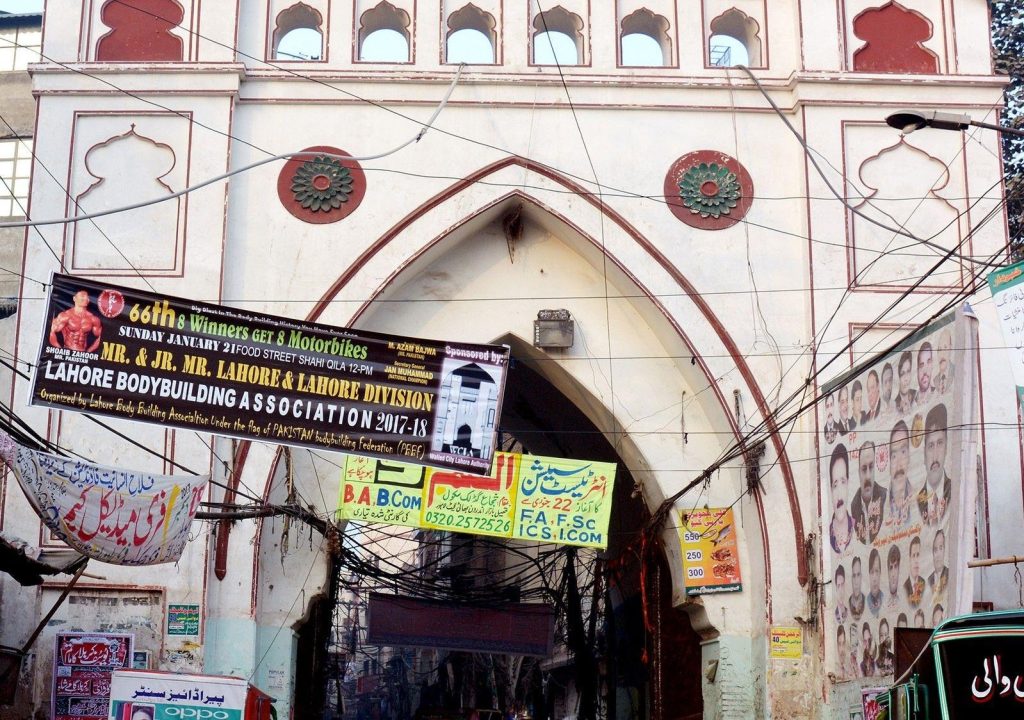
Bhatti Gate, its scalloped arch framed by banners.
Taxali Gate:
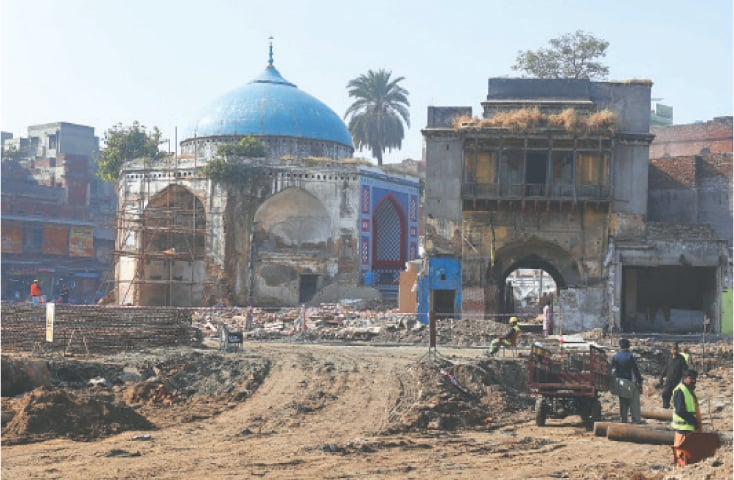
The gate of the royal mint. The taksal, the workshop where Mughal coin was struck, stood here, and the gate took its name from the mint rather than the mint from the gate. The dating of the mint is disputed, with some traditions placing its foundation in Akbar’s reign and others under Shah Jahan, but the outcome is not in doubt: both the mint and the gate have disappeared, and the quarter is now known for its shoe trade and its food. Taxali is one of the gates the present reconstruction programme has taken up first, and it is discussed again at the end of this essay.
North: the gate of lights and the lions
Roshnai Gate:
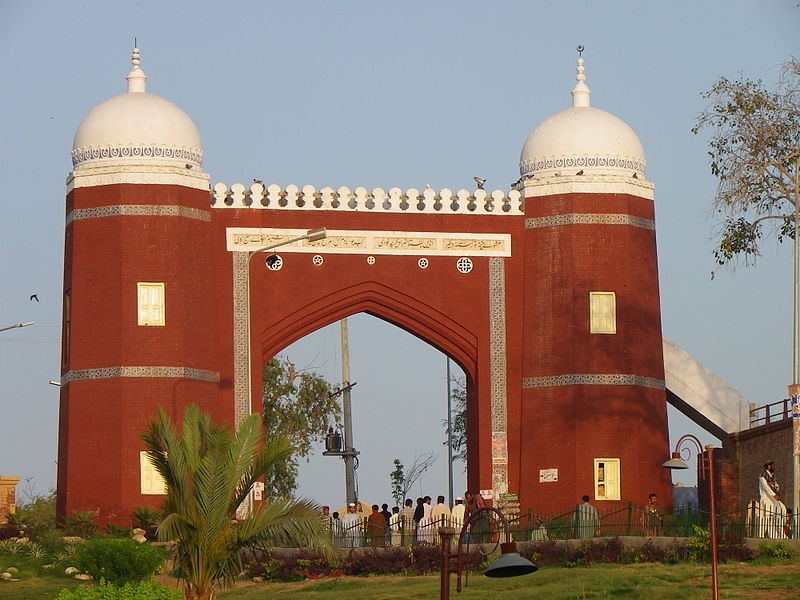
The gate of lights, and the only one of the thirteen to survive in something like its original fabric. It stood at the point where the city met the Ravi, close to the fort and the Badshahi Mosque, and it was lit at night so that processions and travellers moving between the river landing, the fort and the shrine could find their way. Because it faces the imperial precinct rather than a trade road, it escaped the commercial rebuilding that erased its neighbours. It is now the model against which the reconstruction of the lost gates is being designed.
Kashmiri Gate:
Named for the road to Kashmir and for the Kashmiri merchants and quarter behind it, whose cloth bazaar still runs off the gate. The present structure is a colonial rebuild of the late nineteenth century, in a style almost identical to Sheranwala Gate, which was rebuilt in the same period. The distinction matters for anyone interested in authenticity: what stands at Kashmiri Gate today is a Victorian interpretation of a Mughal type.
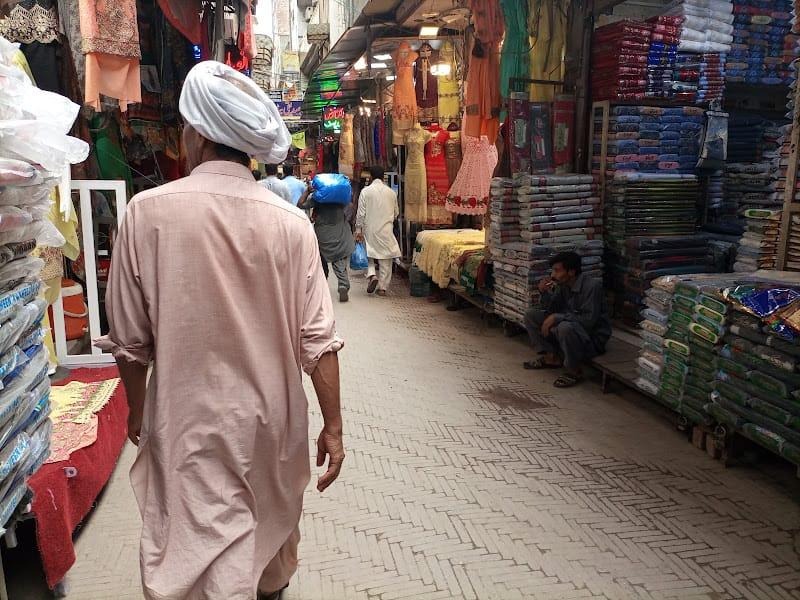
The cloth bazaar inside Kashmiri Gate, where the trade that named the quarter continues.
Masti Gate. The most mysterious of the thirteen, and the clearest example of a name drifting away from its origin. The tradition recorded in the scholarly literature is that the gate was Masjidi, the gate of the mosque, after the great mosque at the gate, and that Masjidi decayed in speech into Masti. A rival tradition credits a royal guard named Masti Baloch, whose long service earned the gate his name. The structure no longer exists. The story does, which in Lahore is a kind of survival.
Khizri or Sheranwala Gate:
The gate of the water saint, renamed by a Sikh king. It opened onto the Ravi, and was dedicated to Khwaja Khizr, the patron of rivers and boats, which is why the old name is Khizri. In the reign of Maharaja Ranjit Singh the name changed: lions were kept caged at the gate, whether as symbols of sovereignty or as a deterrent, and the gate became Sheranwala, the place of lions. The present structure is a colonial rebuilding, like Kashmiri Gate beside it.
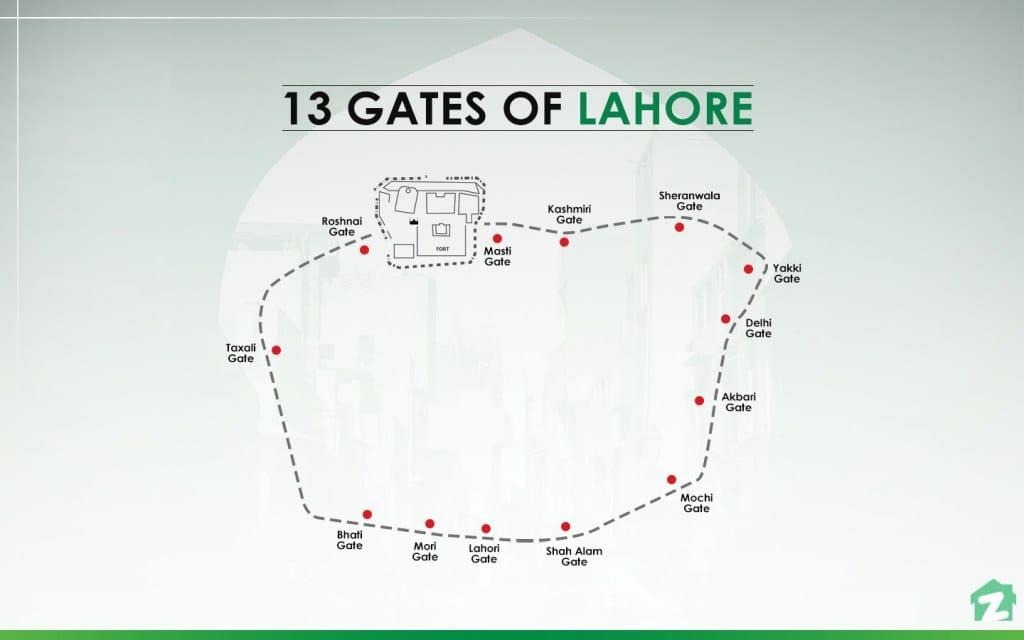
The circuit of the thirteen gates as mapped in a Zameen guide to the gates of Lahore, with Sheranwala and Kashmiri on the northern side and Roshnai at the fort
What happened to the wall
The gates did not fall in battle. They were dismantled by administration. When the British annexed Lahore in 1849, the defensive circuit lost its military justification, and the walls were razed and replaced by the Circular Gardens, which were themselves converted into Circular Road in the 1960s. The lowered ramparts, the new roads, the railways and the commercial rebuilding of the colonial city did the rest. This is the argument of A. M. Sheikh’s Lahore’s Lost Walls and the Thin Girl with an Iron Will (Sang e Meel, 2019), and of the wider literature on colonial Lahore, which reads the erasure of the wall as the moment the city stopped being a fortified place and became a provincial capital.
The result, today, is six surviving gates of varying integrity and a set of names that outlive their buildings. Roshnai is original. Delhi, Lahori, Bhatti, Kashmiri and Sheranwala stand as colonial or later rebuildings. Akbari, Mochi, Shah Almi, Masti, Yakki and Taxali were lost, and Mori was never a full gate to begin with.
The gates that are coming back
The reconstruction now under way is the most ambitious attempt to reverse that loss. The Punjab Walled Cities and Heritage Areas Authority, the body formerly known as the Walled City of Lahore Authority and now generally shortened to PWCA, is working through the surviving and lost gates with the Aga Khan Trust for Culture. Its own account of the programme is explicit: six of the remaining twelve gates are being rescued, the work begins with Taxali and Shah Alam, and the new structures are to be modelled on Roshnai Gate, the one survivor that still speaks in the Mughal manner, rather than on the colonial or Sikh rebuildings that followed.
That choice of model is a scholarly decision as much as an aesthetic one. To rebuild Taxali and Shah Alam on the Roshnai pattern is to say that the thirteen gates belong to a single Mughal conception, and that the colonial gates are witnesses to a later layer rather than the thing itself. It is a defensible position, and it is also a contestable one, which is exactly what a serious conservation programme should be having out in the open.
The reconstructions rest on a technical base that did not exist a generation ago. Three dimensional laser scanning and photogrammetric documentation have been applied to the Walled City and to the Lahore Fort, including the Alamgiri Gate, creating measured records from which physical form can be studied, monitored and reproduced. The same methods underpin the conservation of the Shah Burj Gate in the fort, completed in 2020, and the restoration of the Picture Wall, finished this year.
Culturise and the gate you can hold
This is where the story becomes something you can keep. As PWCA brings the lost gates of Lahore back into physical existence, Culturise is producing three dimensional models of those gates as souvenirs: the same measured geometry that guides the mason, reduced to the scale of a desk or a shelf.
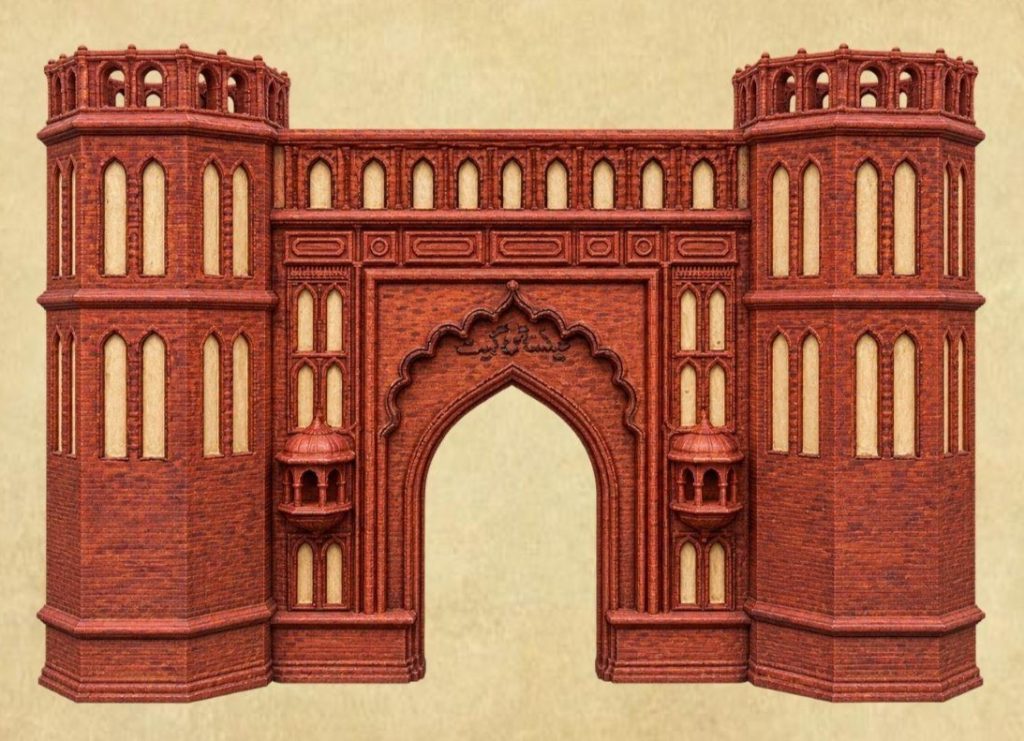
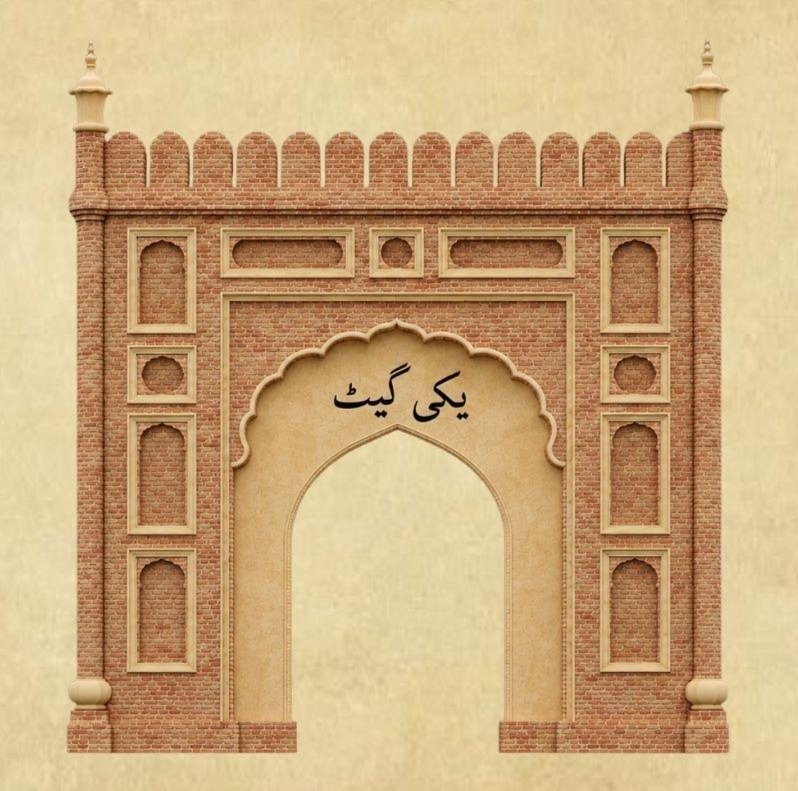
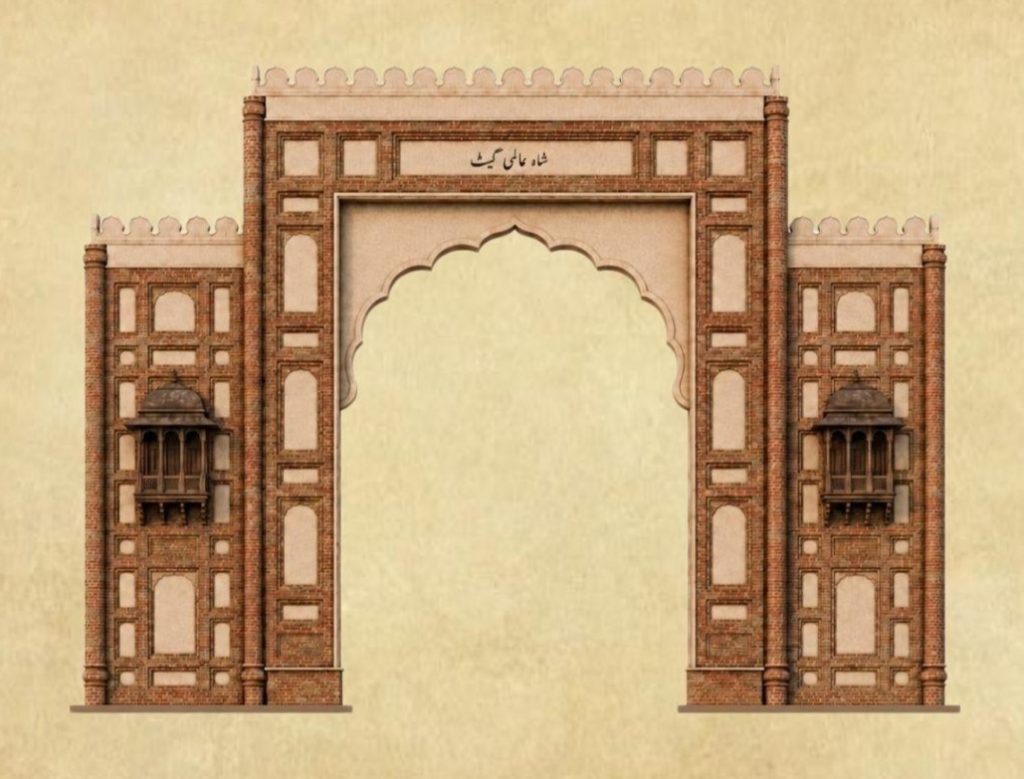
Texali gate, Yakki gate and Shah Alam gate 3d model
The logic is straightforward. A gate is a threshold, and thresholds are the most personal part of a city. Very few people can own a piece of Roshnai Gate or stand inside Taxali at will. A model, built from the documentation of the reconstruction itself, lets someone hold the arch in the palm of the hand, read the scallop of the portal and the line of the parapet, and understand that this is not ornament but infrastructure: the point where a wall became a street, and a city decided who could come in.
Lahore has been counting its doors for four hundred years. For most of that time the count has been going down. It is now, for the first time in a century, going back up, and Culturise is making sure that the gates which return can also be carried home.