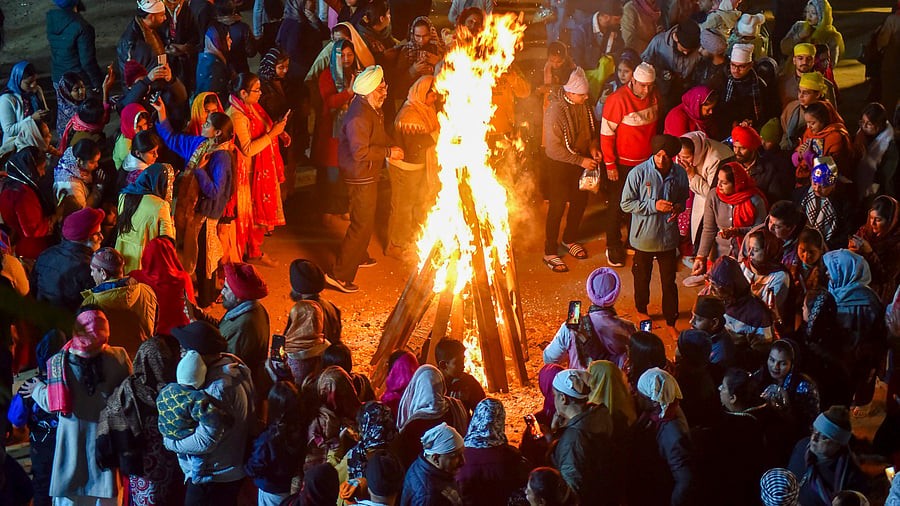
Lohri is one of Punjab’s most ancient festivals, celebrated not only within its borders but across various regions beyond. Known by different names in different areas: Pongal, Sankranti, Khichri, Hadaga, Agadi, Magh Bihu, and Onam. This festival carries a rich tapestry of traditions and stories. Many historical events are associated with Lohri. Some consider it specific to Vedic Dharma, while Hindus celebrate it in honor of the sun deity. However, in Punjab, Lohri is primarily observed as a seasonal festival. Before the partition, it was celebrated by everyone in united Punjab. Lohri is essentially a herald of changing seasons, typically celebrated on the last day of the local month of Poh or during the sugarcane harvest season.
The Legend of Dulha Bhatti: Punjab’s Robin Hood
This festival is intimately connected with a folk tale that revolves around a brave warrior named Dulha Bhatti. His real name was Rai Abdullah Khan, and he hailed from Pindi Bhattian. It is said that he was the foster brother of Mughal Emperor Jahangir. However, when Dulha Bhatti learned that the Mughals had killed his ancestors, he launched a struggle against the Mughal government. Some researchers suggest that this resistance was also against the unjust and excessive taxation imposed by the Mughal government on poor farmers. Both reasons could have been simultaneously valid. According to Ishwar Dayal Gaur, “This local rebellion was so intense that Akbar had to move his capital from Delhi to Lahore for two decades to keep the situation under control.”
The Tale Lives On
Even today, in Pindi Bhattian, the ballad of Dulha Bhatti is sung. Mazhar ul Salam has mentioned this in detail in his book “Lok Punjab” (Folk Punjab). There is an ancient well in Pindi Bhattian that locals believe was near Dulha Bhatti’s house. Additionally, at fairs and gatherings, minstrels narrate Dulha Bhatti’s saga.
One popular story recounts: “One day, Dulha met Emperor Akbar. When Dulha asked who he was, Akbar replied that he was the emperor’s bhat (a servant or attendant). Dulha said, ‘Then I should salute a bhat,’ and moved on. Later, when Dulha reached Akbar’s court, Akbar had installed a door through which one had to bow to enter. But Dulha entered with his legs first, his back facing inside, and his head entering last, refusing to salute Akbar. The emperor offered to forgive 24 years of taxes if he would salute, but Dulha refused, saying he did not salute minstrels.”
A similar tale, with slight variations, is also attributed to Sheikh Ahmad Sirhindi.

The Rescue of Sundri and Mundri
The most famous story associated with Lohri and Dulha Bhatti concerns the rescue of two sisters. It is said that when a man named Mol Chand failed to repay his debt on time, the local landlord kidnapped his daughters, Sundri and Mundri. According to some writers, the landlord had become infatuated with one of the daughters and forced Mol Chand to arrange a marriage, but he refused.
When Dulha Bhatti learned of this, he rescued the girls from the landlord’s clutches and took them to the forest. There, he arranged their marriages to the boys they loved. Since proper arrangements were not available in the forest, Dulha Bhatti himself gathered wood, lit a fire, and placed sugar and sesame seeds in their laps to complete the ritual.
The verses recited during the wedding ceremony instead of traditional mantras have survived as a folk song:
Sundri Mundriye, Tera kaun vichara ho Dulla Bhatti wala ho Dulle di dhi viyahi ho Sher shakkar payi ho Kudi da lal patakha ho Kudi da salu pata ho Salu kaun samete Chacha chori kutti Zamindara lutti Zamindara sudhaye Badde bhole aaye Ek bhola reh gaya Sipahi pher ke le gaya Sipahi ne mari itt Sanu de de lohri Te teri jeeve jodi Bhaanwe ro te bhaanwe patt Sundri Mundriye
(These verses appear with modifications and additions in various places)
The Martyrdom of a Folk Hero
Apart from this tale, it is narrated that Dulha Bhatti was eventually punished for his resistance against the Mughal government. In this regard, Yunus Adeeb writes: “Researchers say that Dulha Bhatti was a disciple of Shah Hussain, and people from the lower classes participated in the rebellion against Akbar under the influence of Shah Hussain’s teachings. It is said that when Dulha Bhatti was hanged at Miyani Sahib in Lahore, Shah Hussain was imprisoned in the Lahore police station. But people witnessed that Shah Hussain was also present at the place where Dulha Bhatti was executed.”
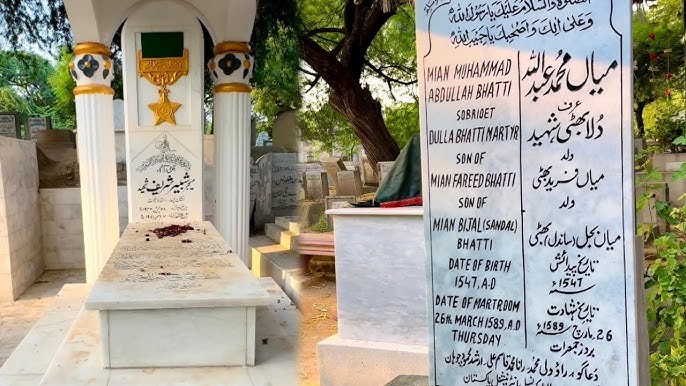
It is a common tradition that Shah Hussain himself received Dulha Bhatti’s body from the government and, after conducting the funeral prayer at Bhati Chowk, buried him on a high mound at Miyani Sahib. There is indeed a grave attributed to Dulha Bhatti in the Miyani Sahib cemetery, near the enclosure of Major Shabbir Sharif, but it was built a few years ago. It is by no means ancient, nor is there any clear statement about it in history. Whether there was a grave here in the past requires further research. At present, it cannot be said with certainty whether this is actually Dulha Bhatti’s grave or not.
Lohri Celebrations in Lahore
Throughout India, wherever the Lohri festival was celebrated with great enthusiasm, Lahore also celebrated it as an important festival before partition. Syed Sharafat Hussain writes: “On cold, dark December nights, the Lohri fair would take place. Large bonfires would be lit, music gatherings would be held, and hot halwa puri would be distributed as prasad.”
Similarly, Mistri Muhammad Sharif recalls his memories associated with Lohri: “On the occasion of Lohri, fires would be lit in the chowks (squares). Bhati Chowk, Lohari Chowk, Shah Almi, Dabbi Bazaar, Kashmiri Bazaar, Sohe Bazaar. Fire would burn in every chowk. In the evening, before 8 or 9 PM. Five, seven, ten year old girls would sing:
Momai de ke ja Dadhi phal powa ke ja
The fire would burn all night…”
A.H. Hamid’s Vivid Memories
A.H. Hamid has written extensively about Lahore and its culture. His memoirs also contain considerable mention of the Lohri festival. He narrates: “In Lahore, when the winter season was at its peak, Hindus and Sikhs would celebrate the Lohri festival. On this occasion, Hindu and Sikh confectioners would especially prepare sweets, chirwa (flattened rice), rewri (sesame candy), and batasha (sugar drops). On the Lohri festival, Hindus and Sikhs would particularly send chirwa and rewri as gifts to each other’s homes.
Small bonfires would be lit in every street, and boys would take kathe (thin sugarcane), place their roots in the fire to warm them, and then strike them hard on the ground, making them burst like firecrackers. Small children would go from shop to shop asking for donations of chirwa and rewri for Lohri, singing a folk song:
Hatti waliya veera Sir sone da chira Sanu mohi mai de Teri jeeve majhi gayan
We would buy chirwa and rewri with the money we received from shops and eat them.”
Traditional Rituals and Customs
Many customs were associated with the Lohri festival, such as Lohri Vyaun (stealing Lohri wood), where boys would bring wood from other areas or villages’ Lohri bonfires. Similarly, groups of children would go from house to house asking for things. Children would stand outside homes and call out loudly together: “Dabba bharia leera da te eho ghar ameeran da” (A box full of small coins, this is the house of the wealthy).
Edward Maclagan writes: “The first Lohri festival after a child’s birth is celebrated with special enthusiasm. Copper coins and cowrie shells are distributed among the poor.”
Tahir Lahori mentions another ritual associated with Lohri, which reveals the literary aspect of this festival. He writes: “The Lohri fair would take place in winter; there was less of a fair and more of a poetry competition. Young people would light bonfires in bazaars, warm themselves by the fire, and compete in verse battles. Winners would be given prizes. Boys would perform bhangra in front of houses and collect money, jaggery, sugar, and other food items.”
A Fading Tradition
Previously, this festival was popular on both sides of the border, but now it is only officially celebrated in Indian Punjab. Very few people organize Lohri celebrations in Pakistan anymore. In fact, many young people are not even familiar with this festival. Before partition, festivals connected with seasons had no particular religious discrimination. But now, considering Lohri a non-Islamic festival, we have expelled it from the country.
Festivals unite us and reduce hatred. Such festivals that “conspire” to bring us together—let us all participate in them. Introduce your children to this festival associated with Dulha Bhatti. Along with Ertugrul, arrangements should be made to familiarize the children of the nation with characters like Dulha Bhatti, so they too know that not all warriors were Arabs and Turks, some belonged to their own soil. The people of Punjab, in particular, should especially organize it so that dying traditions can be saved from extinction.