A Haveli That Holds More Than Stone
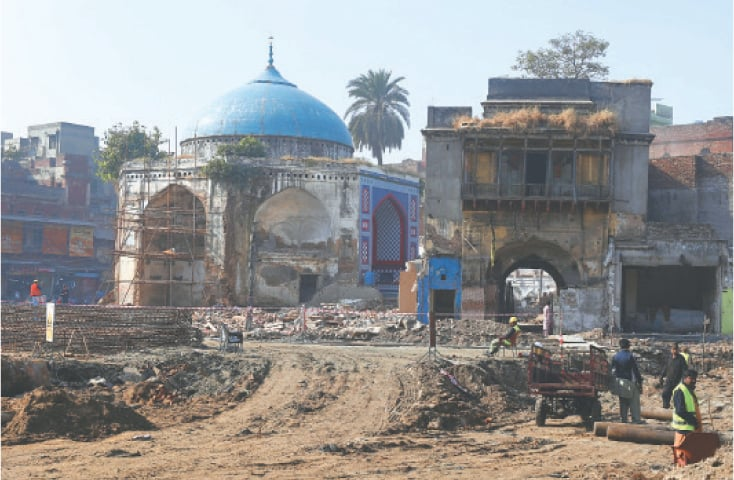
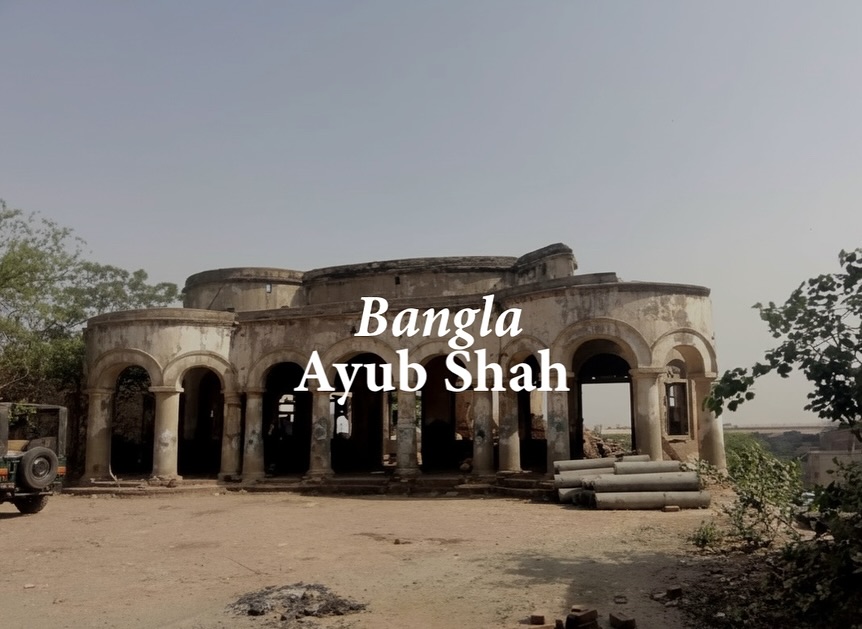
There is a lane inside the Walled City of Lahore that carries a name heavier than most people realize. Gali Bangla Ayub Shah, branching off where the old Gali Purani Kotwali meets the tail end of Kashmiri Gate Bazaar, leads you to a structure that the city has been slowly swallowing for decades. What remains of Bangla Ayub Shah today is a battered Roman-style veranda flanked on both sides by concrete commercial plazas, a mound of old small bricks, and a silence that feels charged with unresolved history.
But the story of this place goes far deeper than what any official record, heritage listing, or newspaper article has yet captured. CultuRise has been privileged to receive a first-hand account from a direct descendant of the family whose story is inseparable from the walls of this bangla. What follows is both the documented history and the untold truth behind one of Lahore’s most extraordinary buildings.
The Origins: Foundations Older Than the Building Itself
The land on which Bangla Ayub Shah stands is believed to be one of the oldest occupied sites in the ancient city of Lahore. Historians and heritage researchers have noted that long before Emperor Akbar raised the great brick walls of the Mughal city, this elevated position at the northernmost tip of old Lahore held significance. References within Abul Fazl’s celebrated Ain-i-Akbari hint at a grand haveli at the highest point of the city, and some scholars have proposed that this very site may have once been connected to the Haveli of Nur Jehan, or even that Emperor Akbar himself may have resided here during his first arrival in Lahore. Serious archaeological research is still needed to confirm this, but the existing Mughal-era foundations beneath the later Sikh-period construction lend the idea considerable weight.
The structure that came to bear the name Bangla Ayub Shah was built during the Sikh era in the nineteenth century, raised upon those ancient Mughal foundations. Its original owner in this period remains unknown, but the haveli was among the grandest private residences in the walled city, occupying a commanding position near Kashmiri Gate.
1849: Enter Ayub Shah, and the Cover That Changed Everything
With the fall of the Sikh Empire and the British conquest of Lahore in 1849, the city entered a period of profound transformation. Afghan and Turkoman chieftains arrived in the wake of the British advance, some pledging allegiance to the new order of the East India Company. One of these was an Afghan officer by the name of Ayub Shah, who came from Kabul and took possession of the vacant, damaged Sikh-era haveli. The British provided him with funds to repair it, and he undertook a significant rebuilding of the structure. The building came to bear his name.
Shortly thereafter, Ayub Shah sold the haveli. And this is precisely where recorded history ends, and the truth this publication has been entrusted with begins.
The Hidden Story: A Royal Refuge in Plain Sight
What existing accounts describe as a straightforward property sale was, in fact, an act of quiet political genius born of desperation and love for family.
The man behind the acquisition was Shahzada Sultan Ibrahim Jan Sultan Durrani, a direct descendant of Sultan Ahmed Shah Durrani, the founder of Afghanistan. As the East India Company consolidated its grip over the subcontinent, members of Afghan royal lineages found themselves in mortal danger. The EIC was actively seeking to neutralize potential threats to its authority, and families of royal Afghan descent were among those targeted for assassination.
Sultan Ibrahim Jan needed to move his family and a number of related households to safety. He chose the Walled City of Lahore, dense, labyrinthine, and difficult for outsiders to navigate, as their refuge. But purchasing such a grand and notable property openly, as a royal Durrani prince, would have immediately drawn the attention of EIC intelligence and endangered the very people he was trying to protect.
The solution was the cover provided by Officer Ayub Shah. Ayub Shah served as the visible face of the acquisition. The reconstruction, the purchase, and the early occupation were all conducted under his name, while Sultan Ibrahim Jan quietly financed the entire operation and arranged the secretive, staged relocation of multiple families to safety within the haveli’s walls. Once the families had been successfully settled and the danger of immediate discovery had passed, the formal handover was conducted, with the property officially transferred to Shahzada Sultan Ibrahim Jan. The cover-up had served its purpose.
This context transforms Bangla Ayub Shah from a mere property transaction into a story of courage, subterfuge, and dynastic responsibility at one of the most dangerous junctures in the history of the subcontinent.
The family’s lineage is as follows:
Sultan Ahmed Shah Durrani founder of Afghanistan, ancestor of the line
Shahzada Sultan Ibrahim Jan Sultan Durrani great great great grandson of Sultan Ahmed Shah Durrani; mastermind of the Lahore refuge
Shahzada Salay Muhammad Jan Durrani his son
Shahzada Ahmed Siyar Durrani his son
Shahzada Munim Siyar Durrani his son,
Shahzada Izmerai Munim Durrani his son, who provided firsthand information for this blog.
The Shahzadas of Lahore: A Dynasty That Shaped a City
Once Sultan Ibrahim Jan had secured the bangla, his family established itself as one of the most prominent households Lahore had ever seen. He also purchased a second magnificent haveli directly opposite the bangla, known as Haveli Daddu Khana, which served as the stables for his extraordinary collection of horses. According to Noor Ahmed Chishti’s Tehkekat-i-Chishti, the Shahzadas’ horse collection surpassed even that of the Company Bahadar itself.
Sultan Ibrahim Jan had three sons. Together they became celebrated across the city as the Three Shahzadas of Lahore:
Shahzada Salay Jan (Salay Muhammad Jan) whose sons included Shahzada Alamgir, who rose to become Home Secretary of West Pakistan and was among the most powerful figures of the Ayub Khan era; Shahzada Sayar, Director of the Persian Language Service at Radio Pakistan; and Shahzada Sultan, a senior Punjab Police officer.
Shahzada Moazzam whose six sons were all accomplished sportsmen of the highest order. His son Shahzada Azam, a Major in the British Army, played hockey for Afghanistan at the 1936 Berlin Olympics. That team was effectively the entire Afghan Club of Lahore, which the British Indian Hockey Federation had overlooked. Their cousin King Zahir Shah personally facilitated their participation, and the Afghan Club of Lahore entered the history books as Afghanistan’s only Olympic medal winning team. This same core group of players later formed the backbone of the first Pakistan hockey team in 1947 and 1948. Shahzada Khurram won an Olympic gold medal for Pakistan in hockey, while Shahzada Shahrukh won an Asian gold in cycling and also represented Pakistan in hockey.
Shahzada Yousaf whose son Shahzada Asif served as a tehsildar.
In their prime, the Shahzadas were the wealthiest family in Lahore. Their household shaped the cultural character of the Rang Mahal neighbourhood to such a degree that merchants and shopkeepers in the area continued to converse in Persian well into the mid-1960s, long after the family had begun to disperse. Their name appears in the British Government of the Punjab’s compilation of the Chiefs of the Punjab.
Architecture: What the Building Spoke in Stone and Wood
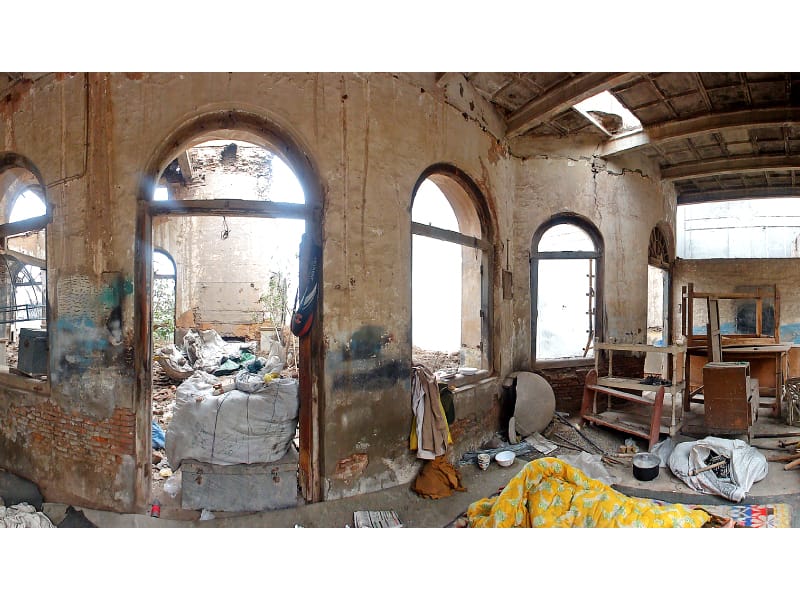
In its complete form, Bangla Ayub Shah was a three-storey structure with two basements and a ground floor, an unusual configuration that speaks to both its defensive origins and its layered function as a private sanctuary. The building was constructed with the characteristically small, dense Lahori brick of the period, a material renowned for its durability. The roofs were composed of a wooden beam and batten system, lending the interiors a warm, resonant character that modern concrete construction cannot replicate.
The exterior and interior walls were finished in lime plaster, the medium through which much of the ornamental and decorative work of the period was expressed. Across the façade, the building presented a Roman-style veranda, an architectural element that reflects the hybrid influences of the nineteenth century, the collision of Mughal, Sikh, Afghan, and colonial architectural sensibilities that gives Lahore’s walled city its distinctively layered visual language. The underground component of the building was perhaps its most remarkable feature. Bangla Ayub Shah sat above a network of secret tunnels that connected it to the Royal Dungeons of the Lahore Fort. From those dungeons, two tunnel branches extended outward: one heading west to emerge near the banks of the River Ravi, which in that era flowed barely half a mile to the west of the city; the other heading east to surface near the Nakkas Khana, outside Delhi Gate. These tunnels, used historically as escape routes during sieges and crises, were remembered vividly by the Shahzada children who played in them during summers, exploring their cold stone depths well into the 1960s.
The Current Situation: What Remains, and What Has Been Lost
By the 1960s, the Shahzada family had begun to sell portions of their vast inheritance. The scale of their holdings, once including agricultural lands and multiple havelis, gradually contracted. Haveli Daddu Khana, the magnificent horse stable opposite the bangla, was gifted to a distant family member. High-rise commercial plazas rose where gardens and courtyards had once stood. Today, only approximately one third of the original bangla’s footprint survives. The two basements and upper floors have largely collapsed or been demolished. What remains is the Roman-style veranda and fragments of the original structure’s skeleton.
The Walled City of Lahore Authority (WCLA), after years of effort, eventually secured official possession of Bangla Ayub Shah from the City District Government of Lahore (CDGL). WCLA Director General Kamran Lashari described it as a long-awaited move, stating that the immediate priority was to stop further deterioration before any re-use plan could be considered. Spokespeople for the WCLA have acknowledged that the building, if restored, has the potential to become a café, museum, or gallery, citing its accessible location near the main road and available parking as significant advantages.
Despite this, progress has been painfully slow. On both sides of the surviving structure, commercial plazas loom and press inward. The concern expressed by heritage advocates is not merely that the bangla continues to decay but that the commercial appetite of the surrounding area is actively hostile to its survival. The late Shahzada Tahir Azam, son of Olympian Shahzada Major Azam, co-authored the landmark Dawn newspaper article that brought renewed public attention to the bangla’s plight. In that piece, he expressed willingness to personally take on the conservation project if the WCLA would provide a qualified conservation architect and financial assistance. He had spent many of his childhood nights in the very dungeons and tunnels beneath the bangla. He knew its stones by memory. Tahir Azam passed away a few years ago. His voice was one of the few that combined personal memory with public advocacy for this building, and its absence is itself a loss that the conservation effort must now find a way to honour.
Why Its Conservation Is Not Optional
The case for conserving Bangla Ayub Shah is not simply an aesthetic or nostalgic one. It is an argument about what kind of city Lahore chooses to be, what kind of history Pakistan chooses to preserve, and what obligations the present owes to the past.
It is among the oldest inhabited sites in the walled city. The possibility that its foundations rest on Mughal-era structures, perhaps even earlier ones, means that beneath its stones lie archaeological layers of incalculable value. Once these are destroyed by neglect or construction, they cannot be recovered.
It is a living document of Afghan-Pakistani shared history. The Durrani dynasty, founded by Ahmad Shah Durrani, shaped the political geography of the entire region. The story of the Shahzadas of Lahore is a story of how Afghan royal families became deeply woven into Lahori cultural, civic, and sporting life. Bangla Ayub Shah is the physical address of that story.
It contains a buried secret history of resistance. The tunnels beneath it represent one of the most extraordinary underground networks in the subcontinent’s heritage. These were not decorative features. They were lifelines, escape routes, and in the case of the Durrani family’s use of the bangla, the very infrastructure of a covert sanctuary for people whose lives were under threat.
It is a rare surviving example of mid-nineteenth century Lahori domestic architecture. The small-brick construction, the lime plaster finish, the wooden beam and batten roofing, the Roman-influenced veranda: all of these represent a specific moment in Lahore’s architectural history when multiple civilisational streams converged in a single building. Every structure like this that disappears is a chapter of that history gone forever.
It carries the memory of extraordinary human achievement. The Shahzada brothers who grew up within these walls went on to play for Afghanistan and Pakistan in the Olympics, to direct cultural institutions, to serve in government. Their legacy is part of Pakistan’s national story, and it begins here, in this lane, in this bangla.
And it carries voices we are still only beginning to hear. The account shared with CultuRise reveals that the true history of this building, the strategic cover operation that made it a refuge for royal families fleeing colonial persecution, has never been formally documented until now. Conservation of the building must go hand in hand with the gathering and preservation of the oral and family histories that give it meaning. Stone without story is archaeology. Stone with story is heritage.
A Related Royal Burial Site: Shahzada Graveyard at Shah Abu al-Ma‘ali
Another important site connected to the Durrani royal lineage in Lahore is the Shahzada Graveyard located near the shrine of Shah Abu al-Ma‘ali. This burial ground contain the graves of several members of the Durrani royal family, including Sultan Ibrahim Jan, Sultan Salay Jan, and Sultan Mozzam Jan.
The presence of these graves further reflects how Lahore served as an important refuge and place of residence for members of the Afghan royal household during periods of political upheaval in the nineteenth century. Much like Bangla Ayub Shah, the Shahzada graveyard offers another layer to the story of displaced royalty and their connections to the city.
What Can Be Done
The WCLA’s possession of the site is a necessary first step, but possession without action is only a slower form of loss. What Bangla Ayub Shah needs now is a formally commissioned conservation plan by a qualified heritage architect, transparent public engagement with the descendants and families connected to the site, integration of oral and written family histories into the building’s official heritage record, funding from national and international heritage bodies, and a clear adaptive reuse vision, whether as a cultural centre, a museum of the Afghan Lahori community, or a living heritage site that serves the neighbourhood while honouring its history.
The descendants of the Durrani Shahzadas are still present. The stories are still alive. The building still stands, just barely, but it stands. The window for action is narrow and closing. What is done or not done in the next few years will determine whether Lahore’s most secretly consequential haveli becomes a restored monument or a carpark.