The Mausoleum of Neela Gumbad is one of Lahore’s most recognisable historic structures, situated near King Edward Medical College. According to the leading historians of Lahore, the shrine belongs to Syed Ishaq Maki. Almost all writers agree on this name, though there are varying accounts about his life. Noor Ahmed Chishti provides one of the most detailed descriptions, writing that his name was Abdul Razzaq Syed Maki Sabzwari, originally from Ghazni. He arrived in India during the reign of Sultan Humayun, joined the imperial army, and later, in 1001 AH, entered the service of Hazrat Moj Darya Bukhari. Under his guidance he renounced worldly life and devoted himself to spiritual practice, eventually becoming a revered saint.
Some writers claim he arrived during the era of Emperor Akbar. It is widely believed that he lived a long life and passed away during the time of Aurangzeb Alamgir. Rai Bahadur Kanhiya Lal , Noor Ahmed Chishti, Mufti Ghulam Sarwar Lahori, Pir Ghulam Dastgir Nami, Rao Javed Iqbal, Alam Faqri, Waris Kamil, Muhammad Din Kaleem, Asad Saleem Sheikh, Muhammad Latif Malik, and the editors of Naqoosh Lahore state that he died in 1084 AH, corresponding to 1673 CE. However, Dr Khwaja Abid Nizami and Tahir Lahori suggest the date 1048 AH, while the author of Amaken Lahore places his death even earlier, in 954 AH.
If the traditional view is accepted that he arrived during the reign of Humayun or Akbar and also served in the military, then it becomes less plausible that he lived into the later Mughal era. Very little is known about his early life. Inside the mausoleum there are multiple graves, though none carry inscriptions. Researchers have also noted that his spiritual guide, Moj Darya Bukhari, belonged firmly to the period of Akbar.
As for the tomb itself, accounts suggest that after entering the spiritual path under the guidance of Moj Darya Bukhari, the saint settled permanently in Lahore. The site of the mausoleum was a place he frequented for rest and contemplation, and after his passing his disciples built the tomb over his chosen retreat. Muhammad Din Kaleem writes that the saint had constructed a small cell and a hall here during his lifetime, and that he wished to be buried at this spot. Another tradition, however, claims that Emperor Akbar commissioned the mausoleum.
A popular story associated with Neela Gumbad is mentioned by nearly all his biographers. In the beginning the grave was simple, and it is said that every Thursday a lion would come and sweep the area. Later, Miran Moj Darya Bukhari appeared in a dream to the lodge’s caretaker and instructed him to have a mausoleum built. The construction was then undertaken by a mason named Abdul Ghafoor. Architecturally the mausoleum clearly reflects the early Mughal period. Dr Abdullah Chaghatai analysed it in depth, noting the large elevated dome rising from a brick structure built on an octagonal base. All eight sides contain deep and open arches. The dome bears resemblance to the slightly turnip-shaped dome of Humayun’s Tomb in Delhi and is also double layered like the Delhi structure. He explains that the building stands on diagonal arches, a major feature of Islamic architecture, and considers the mausoleum the oldest surviving domed building in Lahore. He also highlights the turquoise tile work, which resembles pre Mughal examples in Delhi and strengthens the argument for an early Mughal date.
The mausoleum suffered greatly during the Sikh and British periods. Kanhiya Lal records that a grand garden once surrounded it, but this was destroyed during the Sikh era. Ranjit Singh used the structure as a gunpowder store, and an arms manufacturing workshop operated nearby. Rao Sahib mentions that houses for blacksmiths were constructed close to the mosque, where they produced firearms. During British rule, the building was altered and used as a mess for soldiers. When the cantonment shifted from Anarkali to Mian Mir, the structure was vacated. Munshi Najmuddin, a contractor, requested that the mausoleum be restored to public use and later supervised its repair. In front of the tomb once stood Sheikh Rahim Bakhsh’s inn, remnants of which can still be seen.
Next to the mausoleum is a mosque that appears to be of the same period. Maulana Muhammad Idrees Kandhlawi and the former khateeb of the Badshahi Mosque, Maulana Ali Asghar Abbasi, were associated with this mosque. Inside the mausoleum lies the central grave with a plaque bearing the name Syed Abdul Razzaq Maki. The remaining graves are unmarked and smaller in height. A plaque outside reads the saint’s full lineage, describing him as Suhrawardi, Sabzwari, and Qadiri, as well as the disciple and deputy of Hazrat Miran Sarkar Moj Darya Bukhari, which suggests his affiliation with more than one spiritual order. The decorative interior patterns appear to have been restored in recent decades.
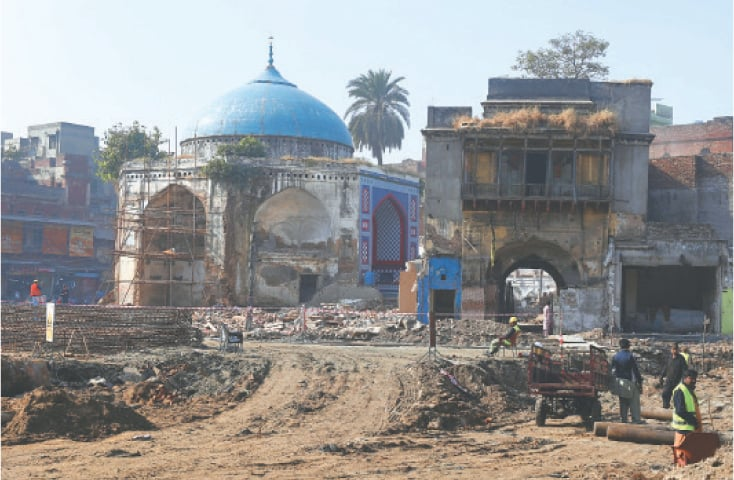
Neela Gumbad Chowk was once a major landmark. A statue of King Edward stood here, and the medical college was also named in his honour. One proposal for Allama Iqbal’s burial suggested the fountains near Neela Gumbad as a possible site, though the location beside the Badshahi Mosque was ultimately chosen. Some years ago, a well meaning devotee installed modern tiles at the entrance, unfortunately damaging the historical fabric and burying any surviving Mughal era elements under contemporary material. Recently, LAHR has taken up a conservation project to revive and restore the mausoleum, aiming to return Neela Gumbad to its former dignity and prominence.